Every integrity team has lived through the version of digital transformation that was sold as "this will change how your engineers work." The roll-up to that promise was usually a new system, a new interface, a new login, and a year of training for the team to get back to where they were before the project started.
The corrosion engineer is not waiting for that. Their workflow already works. They know how to read a CP survey, how to interpret an ILI report, how to walk a section of right-of-way and recognize what the soil is telling them. Time and experience within this industry have built judgment that helps them recognize when something is off, even when no single data source has flagged it. That judgment is the most valuable asset the integrity organization has. But even the sharpest judgment is limited by what the engineer can actually see. The problem is not that the engineer's workflow needs to change. The problem is that the engineer can only see one data source at a time.
What Adding an Intelligence Layer Actually Means
There is a category distinction worth naming. A platform that replaces existing systems is one kind of investment. A platform that sits above existing systems and reads from them is a different kind of investment entirely. The two are often described in the same vocabulary, which is why the integrity manager evaluating a new tool has reason to be careful about what they are actually being asked to adopt.
The VeriCorr model is the second kind. The CP database stays where it is. The ILI vendor's deliverables stay in their native format. The SCADA historian stays connected to the operations team. The GIS platform continues to serve the engineers who depend on it. None of these systems is asked to move, to be migrated, or to surrender control of the data the operator has invested years to capture. The intelligence layer reads from them. It does not replace them.
For the corrosion engineer, this distinction shows up as a practical reality. The engineer continues to log into the systems they have always used. The engineer continues to interpret CP readings the way their training and experience taught them. The engineer continues to walk the right-of-way, to read the report, to make the judgment. What changes is that the engineer now has access to a correlated view that shows the CP reading in the context of the soil chemistry, the inspection history, the operating pressure, and the environmental data that all describe the same foot of pipe.
What the Correlated View Adds
The correlated view does not tell the engineer what to do. The engineer is the one qualified to make that judgment, and the model is built to support and enhance the engineer's judgment, not to substitute for it.
What the correlated view adds is the relationship between data sources that the engineer has always had to construct in their head. When a CP reading comes in low, the engineer has historically had to pull up the soil map separately, check the inspection history separately, look at the weather data separately, and assemble the picture by mental cross-reference. That assembly is real engineering work, and senior engineers do it well because they have done it for twenty years. Junior engineers do it less well because they are still learning what to look for. The correlated view does the assembly automatically, so the engineer can focus on interpretation rather than on data retrieval.
Your data is already there. VeriCorr produces the intelligence your systems cannot.
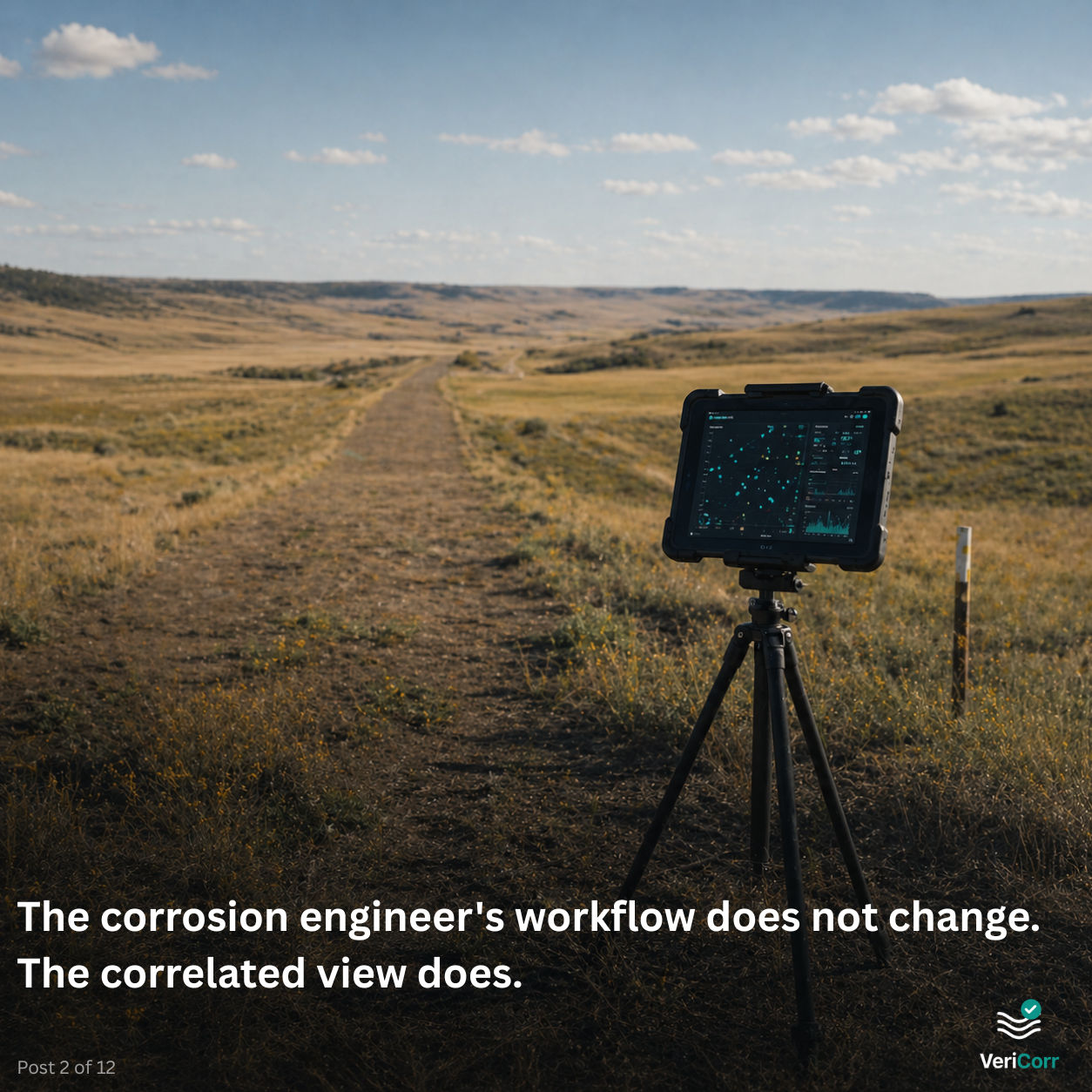
This is what we mean when we say the corrosion engineer's workflow does not change but the correlated view does. The work the engineer was doing yesterday is the same work they are doing today. What is different is that the picture they have always needed is now available in the moment they need it.
What This Means for the Team
There are two practical consequences for the integrity team that we think are worth naming.
The first consequence is that adoption does not require a training program. The team is not learning a new way to do their job. They are gaining a view that makes their existing job more defensible. The view itself takes minutes to learn, not weeks. The interpretation of what the view shows is a function of the experience the team already has.
The second consequence is that the institutional knowledge of the team is preserved and amplified rather than replaced. The senior engineer's twenty years of pattern recognition continues to be the most valuable asset on the team. The correlated view gives that pattern recognition more to work with. The junior engineer learns faster because the assembly work that used to take weeks of mentorship is now visible in the view. The team becomes stronger without anyone losing their footing.
What the Integrity Manager Is Actually Deciding
The integrity manager who adopts a correlated view is not asking the team to accept disruption. They are giving the team a capability the team has been working around for as long as anyone can remember. The decision is not whether the team can absorb a new platform. The decision is whether the team should continue to work without a view that has been technically achievable for years.
If This Reflects a Question Your Team Is Working Through
If your team is working through a related integrity question, we welcome the conversation. Reach us by email at team@vericorr.com, send a note through our connect form, or request a working session on our calendar.
Published by VeriCorr. VeriCorr is a pipeline asset integrity intelligence platform headquartered in Fort Worth, Texas. Correlations across inline inspection, cathodic protection, SCADA, environmental, and regulatory data are presented in a single asset view.